
Share this
by Eve Wu updated on Nov 16, 2026 03:58:18 PM
Table of Contents
- Latest Update (November 2026)
- Background: USCIS’s October 2025 Guidance
- Key Provisions of the Proclamation
- Corrections to Earlier Speculation
- What This Means in Practice
- The Proposed $103,265 H-1B Fee
- What You Should Do If You’re Affected
- Frequently Asked Questions
USCIS Is Not Collecting the $100,000 Payment
Employers are not currently required to pay the $100,000 H-1B payment. Here is where things stand:
- June 8, 2026: A federal court in Massachusetts vacated the agencies’ guidance used to collect the payment.
- July 24, 2026: The First Circuit Court of Appeals refused to pause that ruling. USCIS says DHS will comply with the court’s order while it considers next steps, and that if the order is later lifted, DHS still plans to collect the payment.
- September 18, 2026: A new proclamation extended the $100,000 restriction until September 21, 2027.
- September 30, 2026: A federal court in California also blocked the agencies from enforcing the payment, including the extension.
The courts have blocked the agencies’ collection of the payment, not the proclamations themselves. The government is appealing, and a different federal court in Washington, D.C. upheld the fee in a separate case, so the payment could return if an appeals court rules for the government.
Separately, DHS has proposed a new $103,265 fee for cap-subject H-1B petitions, which would apply to F-1 students changing to H-1B inside the U.S. It is not in effect. See the details below.
For the latest official position, check the USCIS H-1B Specialty Occupations page.
Background: USCIS’s October 2025 Guidance (Before the Court Orders)
On October 20, 2025, USCIS released new guidance clarifying key details about the $100,000 H-1B visa fee introduced in President Trump’s September 19, 2025 proclamation, titled “Restriction on Entry of Certain Nonimmigrant Workers.”
According to USCIS guidance issued on October 20, 2025:
The $100,000 fee only applies to new H-1B petitions filed on or after 12:01 AM ET on September 21, 2025, for individuals outside the United States who do not already hold a valid H-1B visa.
It does not apply to:
- H-1B petitions filed before the effective date;
- Individuals who already have an approved H-1B petition;
- People who currently hold a valid H-1B visa;
- Change of status or extension petitions filed from within the U.S.
The rule is prospective only and does not impact existing visa holders’ ability to travel internationally and return.
USCIS also stated that the payment did not apply to H-1B petitions requesting a change of status for someone inside the United States when USCIS granted that change, and that such beneficiaries would not become subject to the payment if they later traveled abroad and returned on a valid H-1B visa.
This guidance described who would owe the payment when USCIS was collecting it. In June 2026, a federal court vacated the agencies’ guidance implementing the payment, and USCIS is not currently collecting it (see the update above).
Original article (published September 2025):
According to AXIOS’ report and the USCIS announcement, the White House indicated:
On September 19, 2025, the President issued a proclamation — “Restriction on Entry of Certain Nonimmigrant Workers” — to address systemic abuses of the H-1B nonimmigrant visa program. Pursuant to sections 212(f) and 215(a) of the Immigration and Nationality Act (INA) (8 U.S.C. 1182(f) and 1185(a)), the entry of aliens as nonimmigrants to perform services in a specialty occupation under INA section 101(a)(15)(H)(i)(b) (8 U.S.C. 1101(a)(15)(H)(i)(b)) is restricted, except where their petitions are accompanied or supplemented by a payment of $100,000.
This guidance applies to H-1B employment-based petitions filed after 12:01 AM Eastern Time on September 21, 2025. This proclamation applies only prospectively to petitions that have not yet been filed.
The proclamation does not apply to:
- Beneficiaries of H-1B petitions filed before the effective date of the proclamation; or
- Beneficiaries with currently approved H-1B petitions; or
- Individuals who currently hold a lawfully issued H-1B nonimmigrant visa.
All U.S. Citizenship and Immigration Services (USCIS) officers must ensure their decisions are consistent with this guidance. This proclamation does not affect the ability of any existing visa holder to travel to and from the United States.
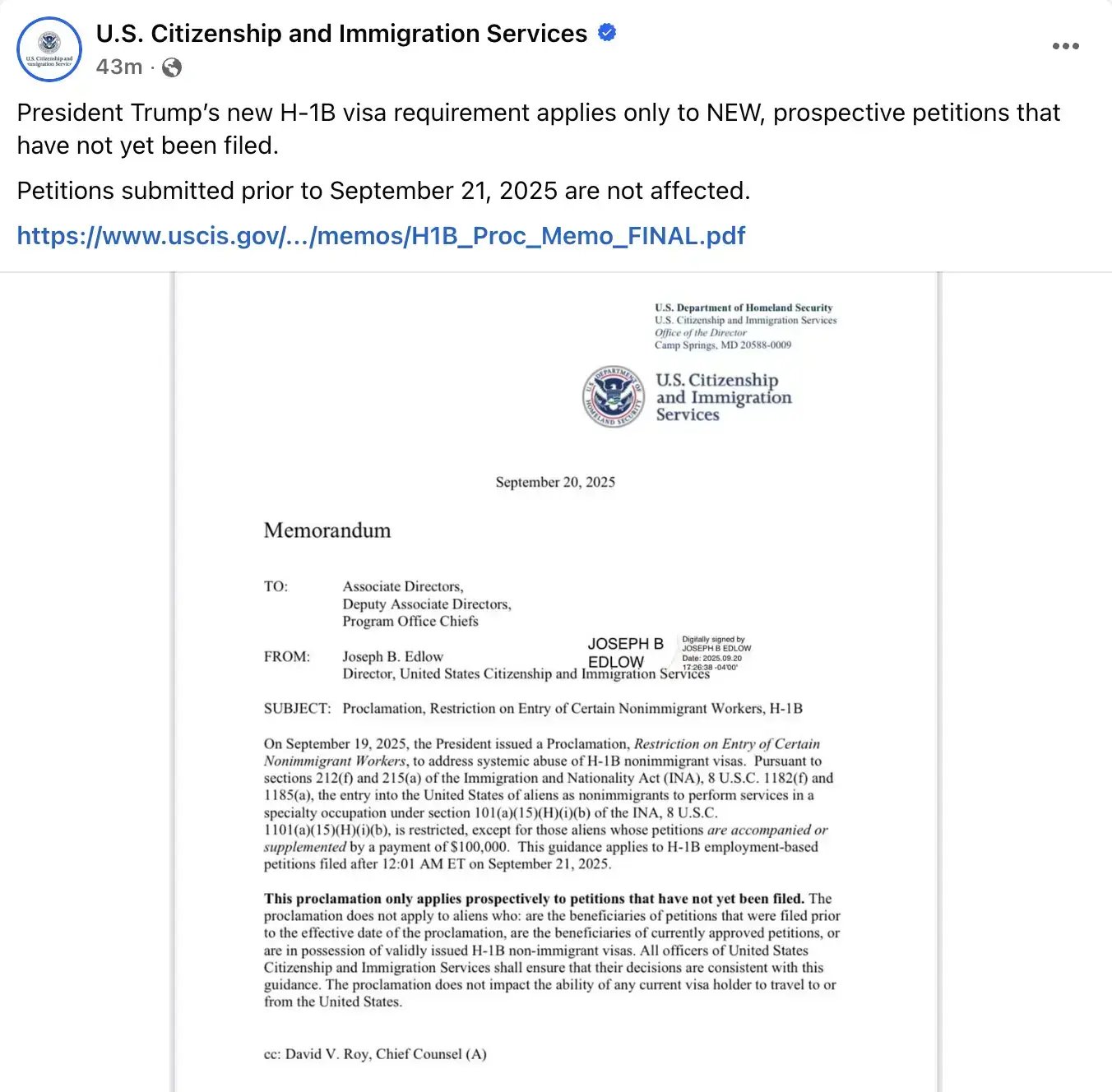
In September 2025, a presidential proclamation introduced a $100,000 payment requirement for many new H-1B petitions. The provisions below describe what the original proclamation said. See the update at the top of this article for its current status.
Key Provisions of the Proclamation
Here are the main points from the official Presidential Proclamation:
- Fee Requirement & Scope
- The proclamation required H-1B petitioners to include a $100,000 payment with certain new H-1B specialty occupation petitions, in addition to existing filing and registration fees. (As of November 2026, USCIS is not collecting this payment because of court orders.)
- This restriction applies to foreign workers outside the U.S. seeking H-1B specialty occupation status.
- Exemptions (“National Interest” Clause)
- There are case-by-case exemptions if the Secretary of Homeland Security determines that hiring the alien is in the national interest and does not pose a threat to U.S. workers’ wages or welfare.
- Valid Period & Entry Restriction
- The original proclamation was set to expire 12 months after its effective date. On September 18, 2026, a new proclamation (Proclamation 11069) extended the restriction until September 21, 2027. Federal court orders currently prevent the agencies from collecting the payment.
- The rule also prohibits the entry of non-immigrant specialty occupation workers unless the payment is made.
- Prevailing Wage Rulemaking
- The Department of Labor is instructed to revise prevailing wage levels under INA §212(n) to align with the goals of this proclamation.
- The Department of Homeland Security is to prioritize high-skilled, high-paid aliens.
- Enforcement, Compliance & Timing
- Employers must obtain and keep documentation showing the payment.
- Visa/consular authorities will verify the payment is made.
- The rule applies to H-1B petitions filed after the proclamation is effective.
- The proclamation required agencies to recommend whether to extend the restriction after the next H-1B lottery. It was extended in September 2026.
Corrections to Earlier Speculation
Given this proclamation, some of the earlier rumors or speculative claims are either clarified or corrected:
- It is now official that there will be a requirement of a $100,000 payment for many H-1B petitions. That part is no longer just speculation.
- The proclamation was time-limited, but it was extended in September 2026 through September 21, 2027.
- Exemptions are explicitly built in (“national interest” cases), so it is not an absolute ban or blanket fee for all H-1Bs.
- The payment was aimed at new petitions for workers outside the U.S. USCIS’s October 2025 guidance said in-country changes of status, extensions and amendments it approved were not subject to it. Since June 2026, court orders have stopped USCIS from collecting the payment at all.
What This Means in Practice
The impacts below were expected when the payment took effect in 2025. While court orders block collection, employers are not paying the $100,000, but many are still planning around it because the payment could return on appeal and because DHS has proposed a separate $103,265 fee.
- Cost Sharp Increase: Companies will need to budget a large upfront cost per petition. Even large firms will feel this.
- Barrier for Smaller Employers & Entry-Level Workers: If your job offer is not high-paying or considered “critical,” companies may decide not to submit petitions under the new fee or may shift roles to locals or remote/offshore.
- Visa Process Delays & Compliance Burden: Verifying payment, documentation, approvals, and navigating exemptions will add complexity.
- Incentive Shift: Employers may bias hiring towards roles with higher salaries or those that clearly fall under the “national interest” exception.
- Alternative Visa Routes & Strategic Planning: O-1, L-1, F-1 + hybrid programs, green card pathways like EB-2 NIW may become more attractive.
The Proposed $103,265 H-1B Fee: Why It Matters for F-1 Students
On August 25, 2026, DHS published a proposed rule that would add a $103,265 fee to every cap-subject H-1B petition, paid by the employer at filing on top of existing fees. This is separate from the $100,000 proclamation payment.
| $100,000 payment | Proposed $103,265 fee | |
|---|---|---|
| Created by | Presidential proclamation (Sept. 2025, extended to Sept. 2027) | Proposed DHS regulation (Aug. 2026) |
| Status (Nov. 2026) | Blocked by court orders; not being collected | Proposed only; not in effect |
| Who it targets | Mainly new petitions for workers outside the U.S. | All cap-subject petitions, including regular cap and master’s cap |
| F-1 student changing to H-1B inside the U.S. | Not covered under USCIS’s 2025 guidance | Would be covered if finalized as proposed |
| Cap-exempt employers (e.g., universities) | — | Not covered |
The public comment period closed on September 24, 2026. The fee cannot take effect unless DHS publishes a final rule with an effective date. If you are an F-1 or OPT student hoping to be sponsored through the H-1B lottery, follow this proposal closely and talk with your employer about how they are planning for it. To understand the process itself, see our guide to changing status from F-1 to H-1B.
What You Should Do If You’re Affected
If you’re an international student, future H-1B hopeful, or employer, consider these steps:
- Review your offer and the employer’s ability to meet high salary/wage thresholds.
- If possible, negotiate salary / job title to fit where exemptions or prevailing wage rules may favor.
- Keep close records of job offers, wage levels, and employer documents. They will matter.
- Follow the appeals of the court orders blocking the $100,000 payment and the status of the proposed $103,265 fee. Either could change your employer’s costs with little notice.
- Explore backup options (other visa types, degree programs with work-authorization components, etc.).
- If you are an F-1 student, ask your DSO and your prospective employer’s immigration attorney how these fees affect your timeline, and consider whether a cap-exempt employer could be an option.
Conclusion
This proclamation is a high-stakes move with major implications.
The $100,000 payment has been one of the steepest barriers ever introduced for H-1B sponsorship. As of November 2026, court orders have stopped USCIS from collecting it, but the proclamation has been extended to 2027, the government is appealing, and DHS has proposed a separate $103,265 fee that would also reach F-1 students changing status inside the U.S.
For those planning their careers, it’s more critical than ever to stay informed, plan ahead, and consider all options. This change shows how immigration policy can shift quickly, and how much those shifts can affect individual lives, careers, and industries.
Feel free to share your story in our community. Let’s bring more transparency to how the system really works.