Applying for Day 1 CPT involves two separate processes: admission to a qualifying university program and authorization for Curricular Practical Training (CPT). After admission, eligible F-1 students generally work with their school’s Designated School Official (DSO) to request CPT. CPT must be related to the student’s major and integral to the curriculum, and employment cannot begin until the DSO has authorized CPT and issued an updated Form I-20. Graduate students may be eligible for CPT during their first semester when their program requires immediate practical training.
Compare Day 1 CPT Universities
| Question | Answer |
|---|---|
| Who authorizes CPT? | Your school's Designated School Official (DSO) |
| Do I file Form I-765 for CPT? | No. CPT is authorized by the DSO in SEVIS |
| Can I start working while CPT is pending? | No |
| Does my job need to relate to my degree? | Yes, it must be directly related to the major |
| Can graduate students use CPT in their first semester? | Potentially, when the curriculum requires immediate practical training |
| What document shows CPT authorization? | An updated Form I-20 |
| Can CPT be full-time or part-time? | Yes |
| Does CPT affect future OPT? | 12 months or more of full-time CPT makes the student ineligible for OPT at that educational level |
New to CPT rules? Read our Day 1 CPT FAQ before starting the application.
Day 1 CPT Eligibility and Requirements
Admission to a university associated with Day 1 CPT does not automatically mean that a student is authorized to work. CPT eligibility depends on the academic program, the student's F-1 status, the training opportunity and authorization from the school's DSO.
| Requirement | What it means |
|---|---|
| Valid F-1 status | The student must maintain valid student status |
| Eligible academic program | Practical training must be an integral and required part of the established curriculum, so the degree cannot be completed without it |
| Required for all students | Under SEVP’s August 2026 guidance, the practical training must be required of every student in the program, international and U.S. alike. CPT tied to an elective course does not qualify |
| Major-related employment | The job or internship must directly relate to the student’s major |
| Employment documentation | CPT must be with an employer that has a cooperative agreement with the school. Schools may also require an employer letter and their own CPT forms |
| DSO authorization | The DSO must authorize CPT in SEVIS |
| CPT I-20 | The student must receive the updated I-20 before starting CPT |
| Program-specific requirements | Schools may impose additional course-registration, GPA, documentation or deadline requirements |
2026 SEVP update: In August 2026, the Student and Exchange Visitor Program (SEVP) issued two Broadcast Messages to school officials: BCM 2608-01 on August 12 and BCM 2608-02 on August 24. Together they narrow how schools may authorize CPT. SEVP’s position is that CPT must be an integral and required part of an established curriculum. It must be required of all students in that curriculum regardless of citizenship, and it must be offered by an employer that has a cooperative agreement with the school. Practical training linked to an elective course does not meet this standard.
Several higher-education organizations have challenged the guidance in federal court (Association of American Universities v. U.S. Department of Homeland Security, D. Mass.). As of November 2026, the court has not ruled, and schools are applying SEVP’s guidance. Some universities have changed or paused their CPT processes in response. Before you apply, ask the university’s international student office how its program meets the current SEVP guidance and whether it is currently authorizing CPT for new students
If you're still deciding where to enroll, review the factors to consider when choosing a Day 1 CPT university before starting an application.
Students concerned about long-term immigration consequences should review the potential risks of Day 1 CPT before enrolling.
When Should You Apply to a Day 1 CPT University?
The best application date depends on your current immigration status, OPT end date, the university's admission deadline, the next program start date, SEVIS transfer timing and the school's CPT-processing procedure.
Students should work backward from the desired program start date instead of waiting until their current work authorization is about to end. Time may be needed for admission review, document collection, SEVIS transfer, course registration and CPT authorization.
| Stage | Action |
|---|---|
| Before application | Compare programs, start dates, tuition and onsite requirements |
| University application | Submit academic and immigration documents |
| After admission | Accept the offer and complete enrollment requirements |
| Before SEVIS release | Coordinate timing with both schools |
| After transfer | Complete new-school requirements |
| CPT request | Submit employer and CPT documentation |
| Before employment | Receive CPT-authorized Form I-20 |
| CPT start date | Begin authorized employment |
Already on OPT? Your SEVIS transfer date deserves special attention. See our complete SEVIS transfer guide before choosing the transfer date.
Exclusive Benefits
Waive Your Application Fee
After-enrollment service
Apply for University Scholarships
$200 Referral Bonus
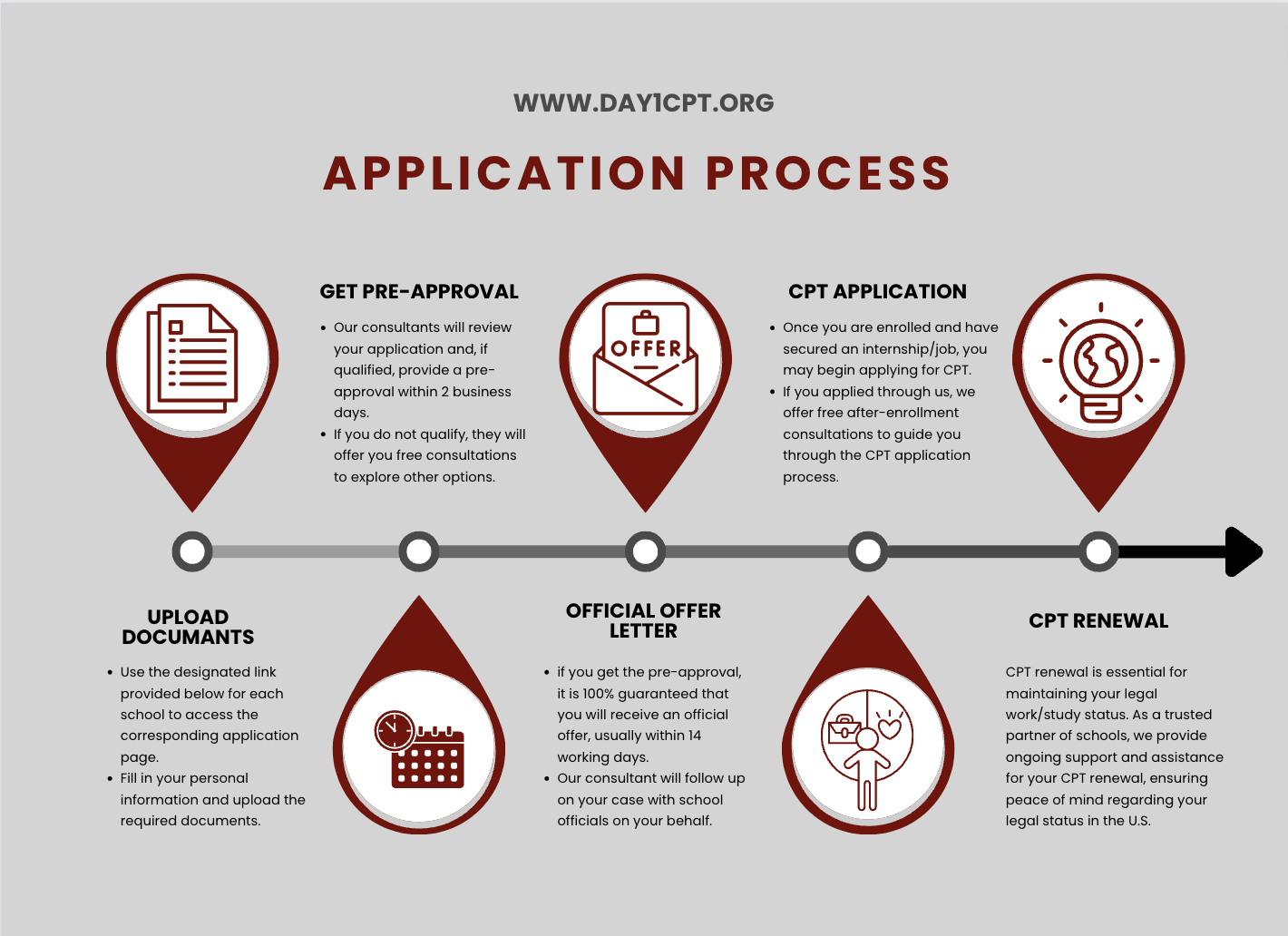
How to Apply for Day 1 CPT: Step by Step
Step 1: Choose an Appropriate University and Program
Start by choosing a program that fits your academic background, career direction, location, budget and work schedule. Do not select a program solely because it offers first-semester CPT.
Compare Day 1 CPT Universities
See the full list of Day 1 CPT Universities
Step 2: Submit Your University Application
Complete the university application and submit all required academic, identity, immigration and financial documents. Requirements and processing times vary by institution.
Step 3: Receive and Review Your Admission Offer
Review the program name, campus, start date, tuition, residency requirement and any conditions attached to admission before accepting the offer.
Step 4: Plan Your SEVIS Transfer
If you already hold F-1 status, coordinate your SEVIS transfer carefully with your current and new schools. The SEVIS transfer process is separate from the university admission process.
How to transfer your SEVIS Record
Step 5: Complete Enrollment Requirements
After accepting your offer, complete every enrollment step the university requires before the program start date. Depending on the school, this may include paying an enrollment deposit, submitting final transcripts or credential evaluations, completing orientation, registering for courses and confirming your onsite attendance schedule.
If you are transferring from another U.S. school, follow your new school’s instructions for checking in with its international student office once your SEVIS record has been released. Your DSO cannot process CPT until your enrollment is complete.
Before you count on a CPT start date, ask the school which course or program requirement the practical training is tied to and when you must be registered for it. Under SEVP’s August 2026 guidance, CPT is only available when practical training is required for every student in the program. Confirm that your program is structured this way. Keep copies of your enrollment confirmation, course registration and Form I-20.
Step 6: Prepare Your CPT Request
Obtain the required employment documentation from your employer and complete the university's CPT request process. The role must be directly related to your major.
Step 7: Receive Your CPT-Authorized I-20
Do not begin CPT employment while authorization is still pending. SEVP states that a student's DSO must authorize CPT in SEVIS before participation begins, and authorization cannot be backdated.
Step 8: Verify the CPT Details Before Working
When you receive your updated Form I-20, review the CPT authorization section before your first day of work. Check that:
- The employer name and work location match your offer letter
- The CPT start and end dates are correct
- The authorization is marked full-time or part-time as you expected
- The form is signed by your DSO
Do not start working before the start date printed on the I-20, even if your employer wants you to begin earlier. If anything is wrong, ask your DSO to correct it before you begin. CPT authorization cannot be backdated, so an error discovered after you start working cannot be fixed retroactively. Keep a copy of the CPT I-20 and give your employer a copy if they ask for it.
Step 9: Maintain Your F-1 Status
CPT authorization does not replace your responsibilities as an F-1 student. While you are on CPT:
- Stay enrolled and attend as required. Register each term and attend all classes and required onsite sessions.
- Work only within your authorization. Work for the employer, dates and full-time or part-time status shown on your I-20.
- Get a new authorization before any change. A separate CPT authorization is required for each employer and each CPT period. Talk to your DSO before you change employers or extend your work dates.
- Request renewals early. Submit renewal paperwork well before your current CPT end date so there is no gap.
- Track full-time CPT. Twelve months or more of full-time CPT makes you ineligible for OPT at the same degree level.
- Keep organized records. Save every I-20, offer letter, transcript and attendance record. These records can matter later, for example if USCIS reviews your F-1 history in an H-1B petition.
For questions about your specific situation, contact your DSO or a qualified immigration attorney.
Day 1 CPT rules and common questions
8 Day 1 CPT Application Mistakes to Avoid
| Mistake | Better approach |
|---|---|
| Applying right before OPT expires | Start planning around admission, SEVIS and CPT timelines |
| Assuming admission automatically gives CPT | Treat admission and CPT authorization separately |
| Starting work before CPT authorization | Wait for DSO authorization and the CPT start date |
| Choosing an unrelated major | Make sure the program and employment relationship is defensible |
| Incomplete employer documentation | Confirm the school's CPT checklist early |
| Missing the CPT course requirement | Verify registration requirements with the DSO |
| Ignoring CPT end dates | Track renewal dates and authorization periods |
| Choosing a school based only on CPT | Review accreditation, curriculum, onsite attendance, tuition and academic progression |
Learn about Day 1 CPT risks and how to reduce them before making an enrollment decision.
If you are concerned about future immigration evidence requests, read our guide to Day 1 CPT and H-1B RFEs.

FAQ
There is no single application deadline for all Day 1 CPT universities. Your timeline depends on the school's admission deadline, program start date, document requirements, SEVIS transfer timing, and CPT authorization process. If you are currently on OPT or STEM OPT, plan early enough to complete admission, transfer your SEVIS record, enroll, and receive CPT authorization before the date you intend to begin CPT employment.
Before selecting your transfer date, review our Day 1 CPT SEVIS Transfer Guide.
You cannot begin employment under CPT until your school's DSO has authorized the CPT in SEVIS and you have received the updated Form I-20 showing the approved employer, dates, and CPT authorization. CPT authorization cannot be backdated, so students should not assume that a pending CPT request permits employment.
For more information about CPT work-authorization rules, see the Day 1 CPT FAQ.
No. CPT is different from OPT. A school's Designated School Official authorizes CPT in SEVIS and issues an updated Form I-20 showing the authorization. Students generally do not file Form I-765 or wait for an Employment Authorization Document to begin CPT employment.
For a broader comparison of CPT rules and eligibility, read the Day 1 CPT FAQ.
CPT requires a specific training or employment opportunity. ICE states that students must secure the training opportunity before CPT can be authorized and that CPT requires a signed cooperative agreement or employer letter. Individual universities may request additional information such as the employer's address, job title, job description, employment dates, weekly hours, supervisor information, or a university-specific CPT agreement.
You can also check our Day 1 CPT Employer List for employer-related CPT information.
Yes. Federal CPT rules require the practical training to be directly related to your major and to be an integral part of the established curriculum. Simply having a job offer is not enough to establish CPT eligibility. Your university and DSO determine whether the proposed employment satisfies the program's CPT requirements.
A CPT authorization is tied to the specific employment recorded by the DSO. ICE guidance states that a separate CPT authorization is required for each employer and each CPT segment. If you change employers or need a new period of CPT, contact your DSO before beginning the new employment rather than assuming your existing authorization carries over.
For employer-specific information, check the Day 1 CPT Employer List.
Potentially, but the employment must separately qualify for CPT under your new academic program. The fact that an employer previously employed you during OPT does not automatically authorize employment under CPT. The job must meet CPT requirements, including being related to your major and integral to the curriculum, and the new school's DSO must authorize it before CPT employment begins.
Using CPT does not automatically mean an H-1B petition will receive an RFE or be denied. However, when reviewing a later change of status from F-1 to H-1B, USCIS may examine whether the student maintained valid F-1 status, followed the academic program, and used CPT in accordance with applicable requirements. Keeping academic, employment, attendance, CPT, and immigration records can therefore be important.
If you wish to apply to Day 1 CPT universities that are not currently included in the above application guides, please contact us by filling out the following form for assistance.
The self-application portal is available only for the aforementioned three Day 1 CPT universities. However, we are actively working on expanding this service to include all the Day 1 CPT universities we collaborate with.
In the meantime, we have prepared a comprehensive step-by-step guide for applying to other Day 1 CPT universities.
If you have further questions, please feel free to book a free consultation with us. Our experts will provide guidance and assist you throughout the application process.
Latest News - Day 1 CPT & Day 1 CPT Universities

Trump Names Stephen Miller Chief of Staff: F-1, H-1B Implications

BIA Ends U Visa Continuance Presumption in Removal Cases

USCIS: OPT and STEM OPT Paper I-765 Filings Go to Chicago


.png?width=424&height=296&name=Screenshot+2023-07-10+at+10.25.56+AM%20(1).png)