
Share this
by Eve Wu updated on Dec 23, 2025 01:54:24 PM
If you’ve been treating the H-1B cap lottery like a pure coin flip, DHS just changed the game: the “lottery” now comes with a wage-level multiplier.
On December 23, 2025, DHS/USCIS released the final rule titled Weighted Selection Process for Registrants and Petitioners Seeking to File Cap-Subject H-1B Petitions. It is scheduled to be published in the Federal Register on December 29, 2025, and becomes effective 60 days later (February 27, 2026)—in time for the FY 2027 H-1B registration season.
Just as important: DHS explicitly states the final rule is issued without modifications to the proposed regulatory text, even after receiving 2,731 public comments.
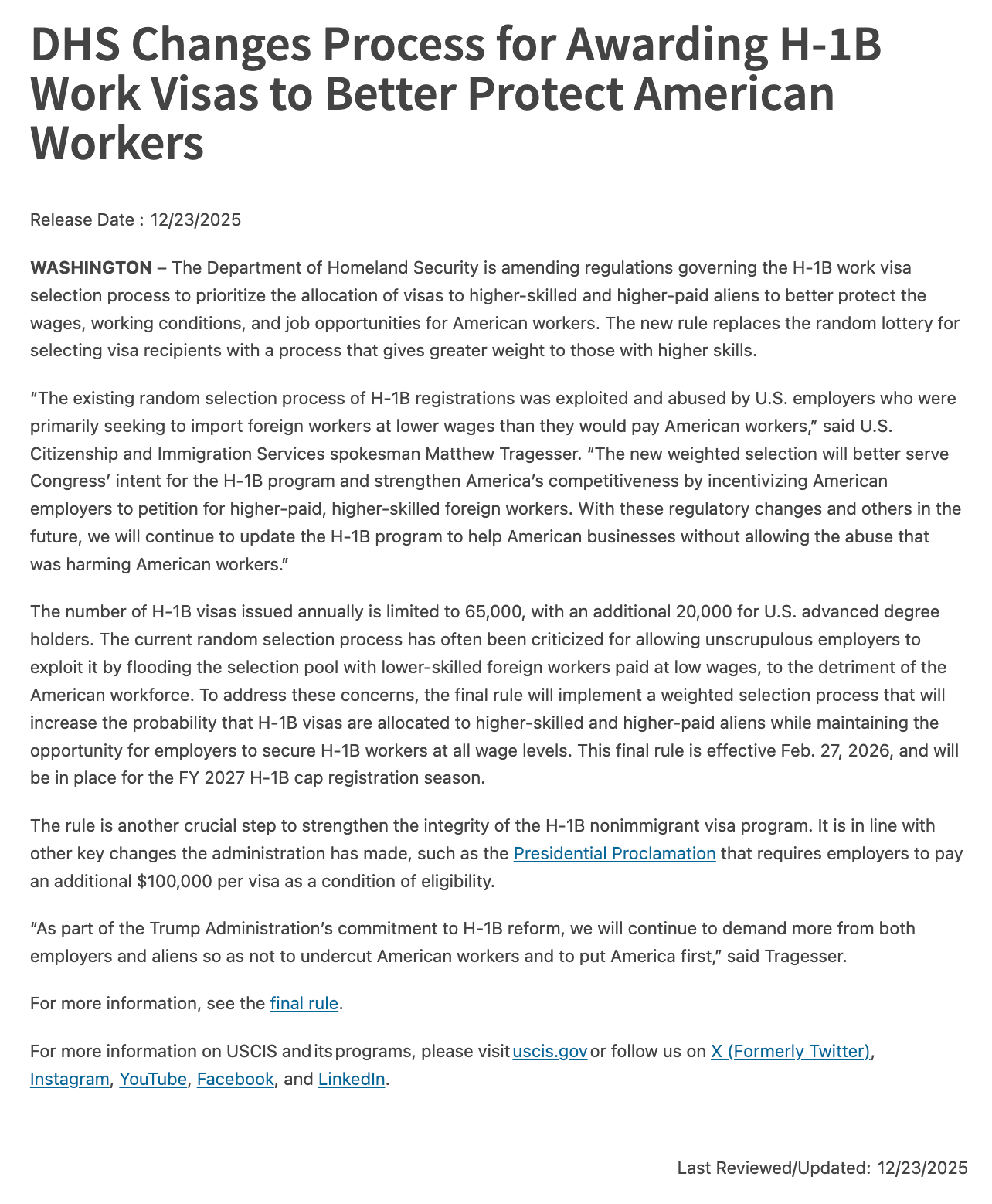
△Sourced from the USCIS website; copyright belongs to the original owner
Key timeline
Here’s the official rollout timeline based on the information provided:
- Final rule posted: Dec 23, 2025 
- Scheduled publication: Dec 29, 2025 
- Effective date: Feb 27, 2026 (60 days after publication) 
- Applies to: FY 2027 H-1B cap season
What stays the same?
The statutory cap structure remains:
- 65,000 regular cap
- 20,000 advanced degree exemption (U.S. master’s or higher)
The two-step selection process that benefits U.S. master’s (and above) candidates also continues. In other words: education still matters—and now wage level matters too.
So the new reality is: higher degree + higher wage = stacked advantages.
What changes (the parts that will hit you in March)
1) Registration now requires wage-level + SOC + location logic up front
Under the final rule, registrants must select the OEWS wage level tied to the offered wage and provide:
- the beneficiary’s salary
- the wage level
- the work location
- the SOC code (Standard Occupational Classification) 
This is a big operational shift because employers can’t “figure it out later”—your registration inputs now drive selection odds.
Before this rule: many of these details were typically finalized later, after selection—when preparing the LCA stage in April. Now, the strategy must be ready before March.
2) Lottery Selection Becomes “Weighted” by Wage Level (Level 1–4 = 1–4 Entries)
Instead of each beneficiary having one equal chance (within the cap structure), USCIS will weight entries like this:
|
OEWS Wage Level |
Entries in the selection pool |
|
Level I |
1x |
|
Level II |
2x |
|
Level III |
3x |
|
Level IV |
4x |
This weighting is based on the highest OEWS wage level the offered wage equals or exceeds for the SOC and location.
Put simply: higher wage level = more tickets in the draw.
3) DHS’s projected odds shift dramatically by level
DHS estimates that under the old random model, each wage level had the same selection probability (29.59%).
Under weighted selection, DHS’s estimates are:
- Level I: 15.29%
- Level II: 30.58%
- Level III: 45.87%
- Level IV: 61.16%
So yes: Level II–IV get a meaningful boost, and Level I drops sharply.
DHS also estimated that if USCIS selects 94,900 registrations in a season (USCIS often selects more than 85,000 to account for drop-off), the composition of selected cases could change like this:
- Level 1 selected share: down 48%
- Level 2 selected share: up 3%
- Level 3 selected share: up 55%
- Level 4 selected share: up 107%
Some independent (unofficial) modeling argues DHS’s calculation may be off—suggesting Level 1 could be even lower than 15.29%, while Level 3 and Level 4 could be even higher than DHS estimates. (This isn’t official, but it’s exactly why early planning matters.)
What this means in real life (especially for OPT / STEM / early-career candidates)
This final rule makes one message painfully clear:
- ✅ Higher education (master’s cap) still helps.
- ✅ Higher wage level now helps a lot.
- ➡️ Together, they create a double advantage for “high degree + high wage” candidates.
If you’re Level I, the “default strategy” is no longer enough
You’ll need to be much more intentional about:
- Choosing a defensible SOC code (not just the closest job title),
- Clarifying worksite location (wage levels are location-sensitive),
- Evaluating whether compensation (base + guaranteed components) can credibly support a higher wage level.
If you’re Level II–IV, the advantage becomes tangible
The new rule is designed to reward higher wage levels. If you’re already there (or can get there with a defensible structure), you’re playing the new game on easier mode—within the same cap limits.
Quick Q&A
When does the H-1B wage-level weighted lottery take effect?
The rule is scheduled to be published December 29, 2025 and becomes effective February 27, 2026 after a 60-day notice period. It applies to the FY 2027 H-1B season expected to start in March 2026.
Does the U.S. master’s cap still help under weighted selection?
Yes. The rule keeps the regular cap and advanced degree exemption structure, and DHS notes the multi-stage process increases the probability for advanced-degree holders.
What exactly must be provided at H-1B registration now?
At minimum, the registrant must select the OEWS wage level tied to the offered wage and provide the SOC code and area(s) of intended employment used for that wage level.
Are DHS’s new “odds” guaranteed?
No—DHS labels them estimates based on assumptions, and notes outcomes can shift if employer behavior changes (e.g., raising wages to improve odds).