
We have talked about the good things about Day 1 CPT in our "Things to Know Before Choosing Day 1 CPT". However, during our consultation, we found that many students considering enrolling in Day 1 CPT courses are concerned about how it may impact their H1B, and later on green card processing. They doubt the legitimacy of the Day 1 CPT program and would like to do some risk management before diving into it.
Rather than dance around the answer, we are committed to offering the most comprehensive reviews and reliable answers. This article intends to address the most common worries we encounter with our students. We will also discuss the past events about day 1 CPT University getting banned by the USCIS.
This is the ultimate insider’s guide to day 1 CPT.
- What is Day 1 CPT
- Pros and Cons of Day 1 CPT
- What the University of Farmington Case Actually Shows
- Can You Travel on Day 1 CPT? Re-entry and Border Risks
- Does Day 1 CPT Affect OPT?
- Does Day 1 CPT Affect an H-1B Application
- Can Day 1 CPT Lead to an H-1B Request for Evidence (RFE)?
- Can Day 1 CPT Affect a Green Card Application?
- Can I use Day 1 CPT after H-1B Status?
What is Day 1 CPT?
Curricular Practical Training is an F-1 employment authorization for practical training that is part of a student’s academic curriculum. Federal regulations describe CPT as training that is an integral part of an established curriculum and require the training to be directly related to the student’s major area of study.
F-1 students generally must complete one full academic year before becoming eligible for practical training. However, the regulation provides an exception for students enrolled in graduate programs that require immediate participation in CPT. The term “Day 1 CPT” is commonly used to describe CPT authorized under this graduate-program exception.
The DSO must authorize CPT in SEVIS, and the student must receive the CPT-authorized Form I-20 before beginning employment. Enrollment in a university or program commonly associated with Day 1 CPT does not, by itself, authorize a student to work.
Students must also continue satisfying their F-1 academic and status requirements while participating in CPT.
How Does Day 1 CPT Work?
Day 1 CPT generally involves five steps:
1. Enroll in an eligible graduate program. The first-term CPT exception applies when the graduate program requires immediate participation in curricular practical training.
2. Obtain qualifying practical training. The training must be directly related to the student’s major and must satisfy the school’s current curricular requirements.
3. Submit the CPT request to the DSO. The DSO reviews the student’s academic eligibility, proposed training, employer information, and other required documentation.
4. Receive CPT authorization before working. CPT employment may begin only after the DSO authorizes it and issues the student an updated Form I-20.
5. Follow the authorization. Students should work only according to the employer, dates, location, full-time or part-time designation, and other conditions reflected in their CPT authorization. Any change should be discussed with the DSO before it occurs.
CPT is therefore different from general employment authorization: the ability to work is tied to the student’s curriculum and specific CPT authorization.
Pros and Cons of Day 1 CPT
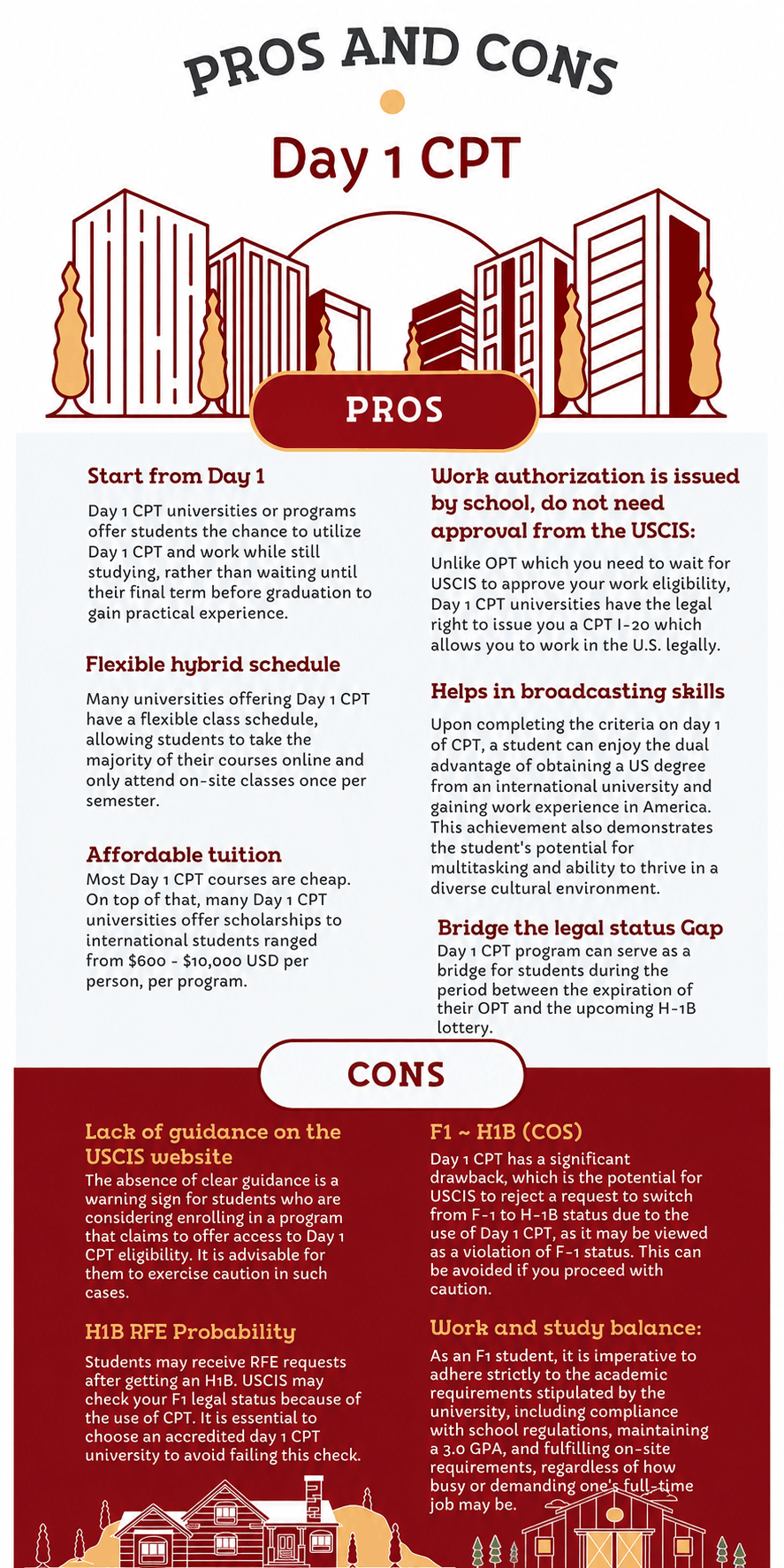
Day 1 CPT has a significant drawback, which is the potential for USCIS to reject a request to switch from F-1 to H-1B status due to the use of Day 1 CPT, as it may be viewed as a violation of F-1 status.
Learn more about Day 1 CPT risks & benefits
Day 1 CPT is not automatically a violation of F-1 status. The main risks arise when a student’s employment, academic program, or CPT authorization does not satisfy applicable requirements.
Curricular eligibility risk. After the August 2026 SEVP guidance, schools are applying closer scrutiny to whether practical training is actually required by the established curriculum. An elective internship course or optional training opportunity may no longer be sufficient.
Unauthorized employment risk. A student should not begin working before CPT is authorized on Form I-20. Working for a different employer, outside the authorized dates, or under materially different conditions without updating the authorization may create status concerns.
OPT eligibility risk. Completing 12 months or more of full-time CPT can make a student ineligible for post-completion OPT. Part-time CPT does not count toward that 12-month threshold.
Future immigration-documentation risk. When a student later requests another immigration benefit or a change of status, the government may require evidence showing that the student maintained lawful status and that previous employment was authorized.
Travel and re-entry risk. CPT authorization does not guarantee admission to the United States after international travel. CBP determines admissibility each time a traveler seeks entry.
Denied Entry Because of Day 1 CPT? Here's How to Avoid the Risks
The best risk-management strategy is therefore not simply choosing a school labeled as a “Day 1 CPT university.” Students should verify the program’s academic requirements, follow the school’s CPT process, maintain genuine academic participation, and keep complete records.
Book a free consultation today, if you are interested but still have concerns in day 1 CPT.
Read More: The Pros and Cons of the day 1 CPT Program
What the University of Farmington Case Actually Shows
Let’s address the elephant in the room!
The University of Farmington case is frequently mentioned in discussions about Day 1 CPT, but describing it simply as students being arrested “because of Day 1 CPT” is misleading.
In January 2019, the U.S. Department of Justice announced charges against eight recruiters for conspiracy to commit visa fraud and harboring aliens for profit. According to the indictments, the recruiters helped foreign nationals enroll in a university that was actually being operated by Homeland Security Investigations as part of an undercover operation.
DOJ alleged that the purported students did not intend to attend school, did not attend classes, and knew that the university had no instructors or actual classes. The government described the case as an immigration-fraud scheme involving false student records and sham enrollment.
The key compliance lesson is therefore broader than CPT: an F-1 student must be a genuine student and must comply with the academic and immigration requirements attached to F-1 status. The Farmington case should not be presented as evidence that properly authorized CPT itself is illegal.
Students can reduce risk by independently verifying a school, participating genuinely in their academic program, following attendance and course requirements, and keeping records showing both academic participation and properly authorized employment.
.jpg?width=798&height=468&name=Risks+of+Day+1+CPT+(2).jpg)
The Truth
Day 1 CPT is designed for international students to get a head start in the American job market. Without a local network and work experience, it might be extremely difficult for an international student to land a job after graduation despite of his/her excellent academic performance and practical experience. However, anything could be abused in a way that betrays its original intention, and so does Day 1 CPT.
There exist other "universities" just like Farmington, which is made up of the ICE. Taking advantage of new immigrants' lack of understanding of the educational system and immigration policy of the U.S., they attract students with programs that are not certificated and thus illegal. Although Day 1 CPT is completely legitimate, such sort of abusive practice is not legally permissible.
We’ve written a guide on how to spot a shady Day 1 CPT university: Maximizing the Benefits of Day 1 CPT while Mitigating the Risks: A Comprehensive Guide
Read through, if you still have questions or are not sure if the school you chose is legit, talk to us, we are here to help.
Can You Travel on Day 1 CPT? Re-entry and Border Risks
Using properly authorized CPT does not automatically prevent an F-1 student from traveling internationally. However, CPT authorization does not guarantee re-entry to the United States.
A valid F-1 visa allows a traveler to request admission at a U.S. port of entry, but Customs and Border Protection makes the final admission decision. The Department of State specifically notes that having a visa does not guarantee entry.
Before traveling, an F-1 student using CPT should review their situation with the DSO and make sure their documents are current. Depending on the circumstances, students should be prepared to present a valid passport, valid F-1 visa when required, properly signed Form I-20, and evidence of current enrollment. Students using CPT may also want to carry their CPT-authorized I-20 and employment documentation.
Students with previous status problems, an expired visa, a pending change of status, or other unusual immigration circumstances should obtain individualized guidance before traveling.
For a full travel checklist, see our guide: Can You Travel on Day 1 CPT? How to Avoid Border and Re-entry Problems.
Does Day 1 CPT Affect OPT?
Day 1 CPT does not automatically eliminate OPT eligibility. The key issue is how much full-time CPT the student uses.
An F-1 student who completes 12 months or more of full-time CPT becomes ineligible for post-completion OPT. Part-time CPT does not count toward this 12-month threshold.
For example, a student who uses full-time CPT for less than 12 months does not lose OPT eligibility solely because of that CPT usage, assuming the student otherwise satisfies the applicable OPT requirements.
Students should keep records of every CPT authorization, including whether each period was designated full-time or part-time and the authorized start and end dates. This becomes especially important for students who use CPT over multiple semesters.
Does Day 1 CPT Affect an H-1B Application?
Students enrolled in Day 1 CPT programs are still eligible to apply for an H1-B visa afterward. It should not affect your change of status (COS) request if you have properly maintained your F-1 status by adhering to the following guidelines:
-
Obtaining the appropriate I-20 before beginning CPT.
-
Knowing the necessary steps to take when extending or modifying the CPT end date.
-
Changing employers.
-
Requesting a transition from full-time to part-time (or vice versa).
-
Maintaining documentation on hours worked and other relevant information.
By ensuring compliance with CPT regulations, students can confidently and thoroughly respond to any requests for information that may arise during the non-immigrant worker's visa application process.
Can Day 1 CPT Lead to an H-1B Request for Evidence (RFE)?
It is possible that students applying for an H1-B visa may receive a Request for Evidence (RFE) regardless of their enrollment in a Day 1 CPT program.
However, accredited Day 1 CPT universities typically have high pass rates that do not affect H1-B approval results.
We’ll give you an example by providing some past data:
Westcliff University is a popular Day 1 CPT university in California. It is also one of our partnered day 1 CPT universities. It has a great record when it comes down to RFE. Less than 10% of its students have received RFEs after getting selected for an H1B visa. 99% of those who did receive RFEs successfully passed them (data from 2021).
Accredited day 1 CPT universities provide their students a “package of evidence” to help with proving their F1 status, though in most cases it is unnecessary.
Besides what day 1 CPT schools can provide, students can also take this matter into their own hands.
Read our blog to get a full list of things you need to do as a day 1 CPT student to ensure the legitimacy of your legal status in the U.S.
Can Day 1 CPT Affect a Green Card Application?
Properly authorized CPT does not by itself prevent someone from later pursuing permanent residence. However, a green card application may involve review of the applicant’s previous immigration status and employment history.
Problems can arise if employment was not authorized or if the applicant failed to maintain status. Whether a past violation affects adjustment of status depends on the immigrant category, the nature and length of the violation, and any statutory exceptions that may apply.
Students using CPT should therefore preserve their immigration, academic, and employment records, including Forms I-20, transcripts, CPT authorization documents, employer records, and evidence showing that they complied with their academic program.
Because adjustment-of-status rules vary significantly by immigration category and individual history, students who believe they may have worked without authorization or violated F-1 status should obtain individualized advice from a qualified immigration attorney.
Can I use Day 1 CPT after H-1B Status?
Yes, you can if you need to.
In some situations, an H-1B worker may change status from H-1B to F-1 and later use Day 1 CPT if they enroll in an eligible academic program and meet all F-1 and CPT requirements. CPT must be directly related to the student's major, be an integral part of the curriculum, and be properly authorized by the school's DSO before employment begins.
A common question is: Can I switch from H-1B to F-1 and use Day 1 CPT after an H-1B layoff? For some professionals, changing to F-1 status and pursuing another degree may be an option, but enrolling in a Day 1 CPT program does not automatically authorize employment. Students must first obtain valid F-1 status and receive proper CPT authorization before beginning CPT employment.
Another common question is: Can I switch back from F-1 to H-1B without entering the H-1B lottery again? It depends on your previous H-1B history. If you were previously counted against the H-1B cap and remain eligible to use time from that H-1B period, a new employer may be able to file an H-1B petition for you without requiring another cap selection. However, not everyone who previously had an H-1B approval qualifies. For example, someone whose previous H-1B employment was cap-exempt or who was never actually counted against the H-1B cap may still need to go through the H-1B cap registration process for a cap-subject employer.
Students considering an H-1B to F-1 to H-1B change of status should review their individual immigration history carefully, including whether they were previously counted against the H-1B cap, how much H-1B time they have used, and whether their future employer is cap-subject or cap-exempt.
Do I Need the H-1B Lottery Again After F-1?
It depends on the person’s previous H-1B cap history.
Under federal law, a person who has already been counted against the H-1B cap within the relevant six-year period generally is not counted again, subject to applicable exceptions. However, having held an H-1B approval does not always mean the person was counted against the cap. For example, some H-1B employment is cap-exempt.
Whether a future employer needs a new cap selection therefore depends on the beneficiary’s previous H-1B history and the type of future employer.
The processing time for this can range from 3 months to a year. You can check the current processing times for Form I-539 by clicking on the link below.
For additional details, please refer to the USCIS guide provided here.
Yes.
You don’t need to apply for the H1B lottery again. You’ll need to make sure your new job accepts H1B transfer and you can “transfer“ your old H1B to your new job.
read our post for detailed answers:
Yes. Federal regulations still permit an exception to the normal one-academic-year CPT requirement for graduate programs that require immediate participation in practical training. However, first-term CPT is not automatically available to every graduate student or every program.
Not necessarily. Following SEVP guidance issued in August 2026, universities report that enrolling in an elective internship, practicum, research, or similar course does not by itself establish CPT eligibility. Students should check their school’s current written policy.
Part-time CPT does not count toward the 12 months of full-time CPT that can make a student ineligible for post-completion OPT.
Verify the school through the DHS SEVP School Search, check accreditation through the U.S. Department of Education, read the program’s published curriculum, and ask the DSO for the school’s current CPT policy and how it is implementing the August 2026 guidance.
Day 1 CPT & Day 1 CPT Universities News
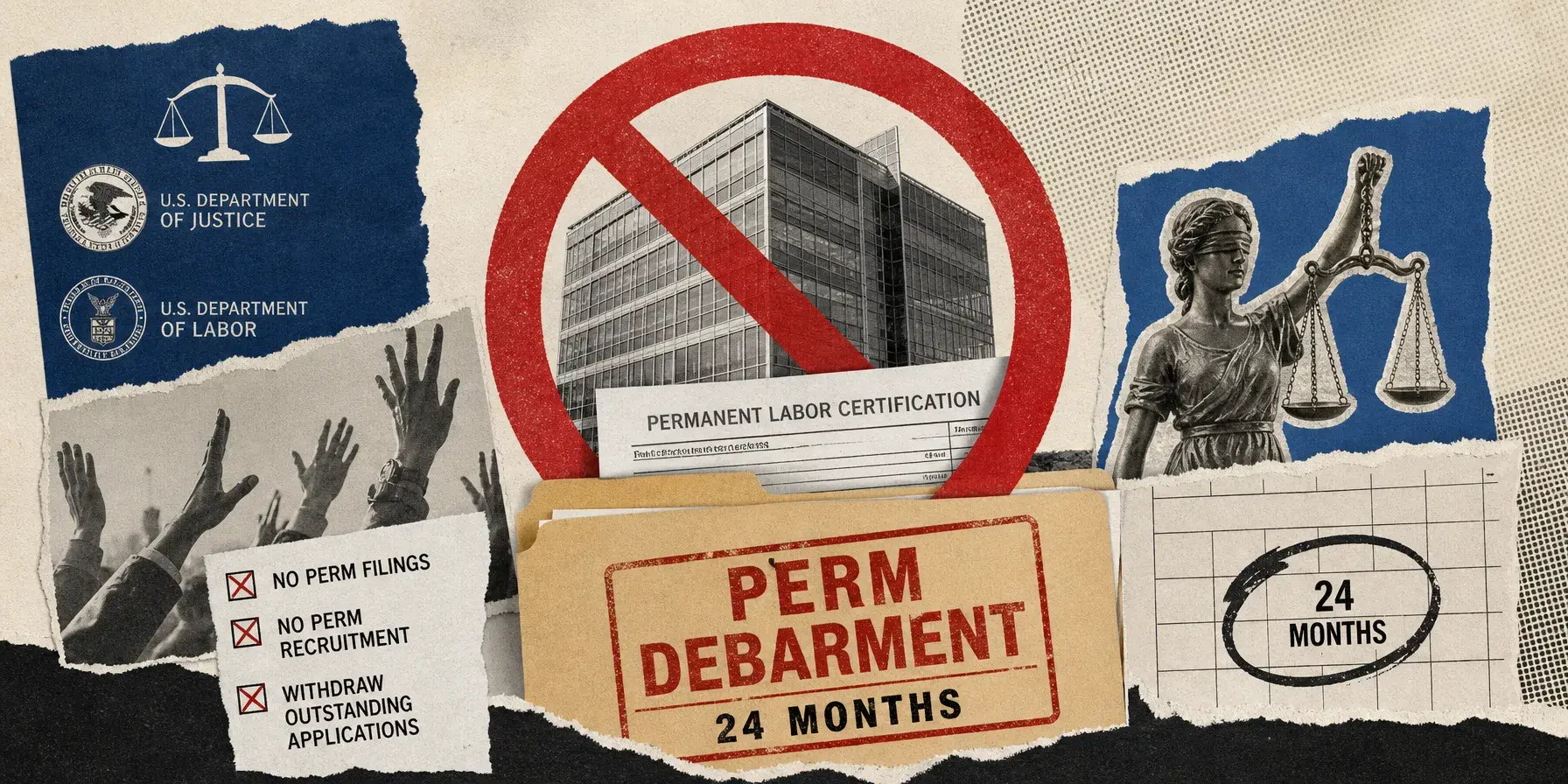
Cloudera Accepts 2-Year PERM Debarment in $2M DOJ-DOL Settlement
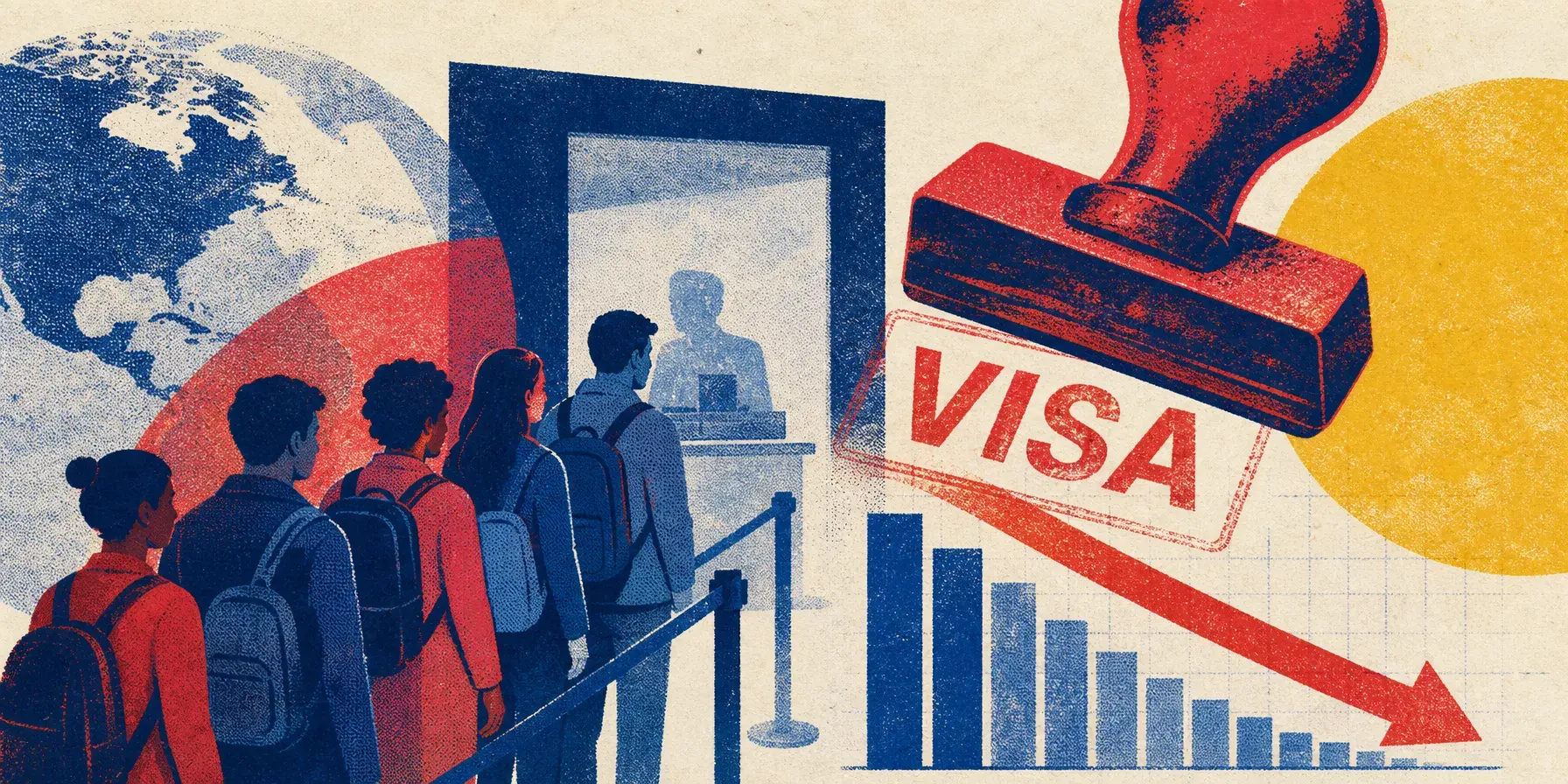
U.S. Immigrant Visa Issuance Halved in February 2026

Infosys, TCS, Cognizant Cut FY 2027 H-1B Registrations