
Share this
by Eve Wu updated on May 7, 2026 01:52:05 PM
Do you remember the major DHS reform proposal released at the end of last August?
For many F-1 international students, this proposal felt like a bombshell. It introduced several potential changes that could significantly affect how students maintain legal status in the U.S., especially those who rely on OPT, H-1B lottery results, school transfers, or Day 1 CPT.
According to the information provided, this proposal has now entered the last step before becoming effective. On May 5, DHS submitted the revised final rule to the White House Office of Management and Budget, also known as OMB, for review.
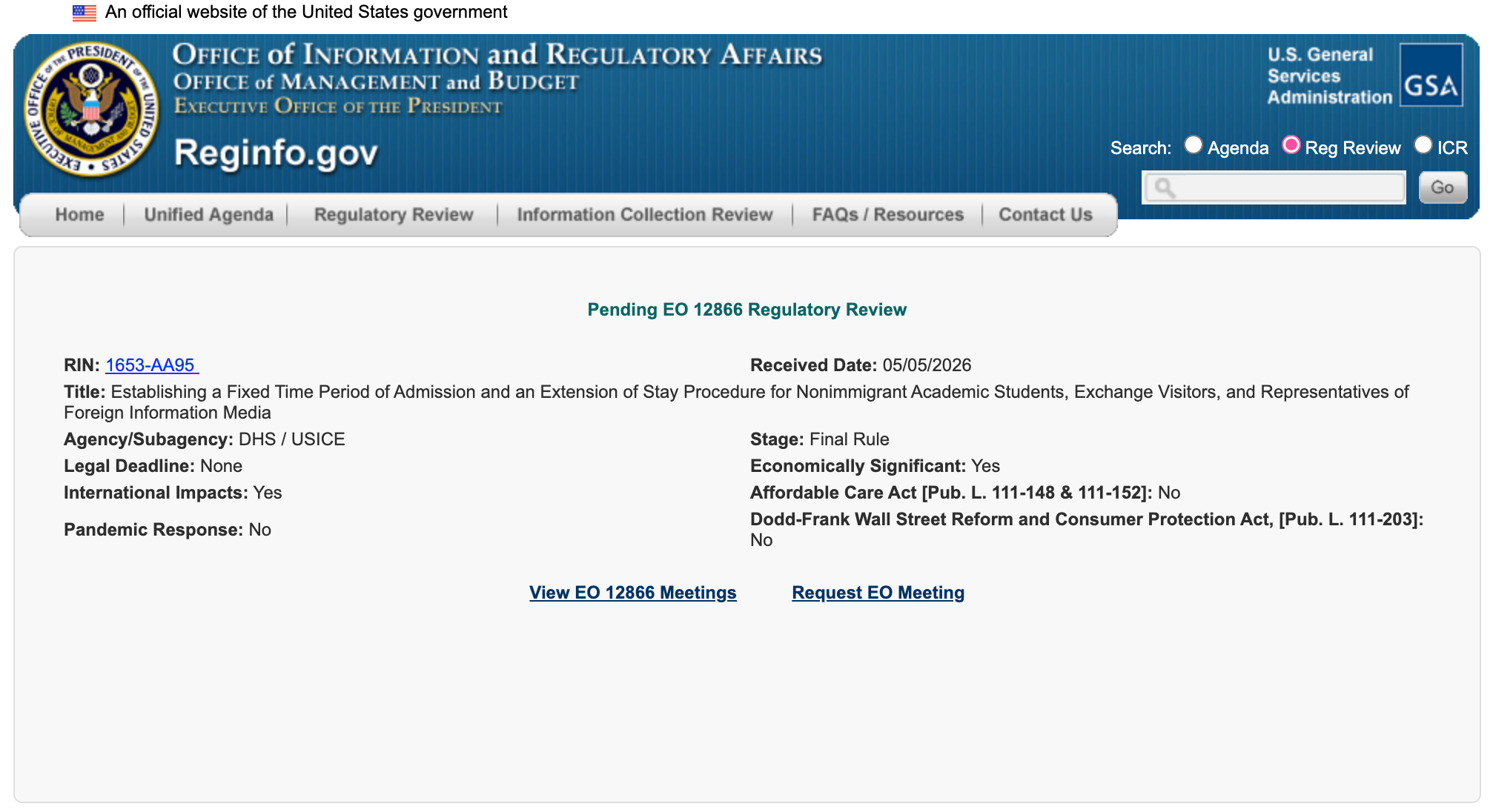
After OMB completes its review, DHS is expected to publish the rule again in the Federal Register for another 30-day public notice period. Based on the current timeline, the rule may take effect around the fall semester, which makes this especially urgent for F-1 students planning their next academic or work authorization step.
For students who were not selected in this year’s H-1B lottery, this rule matters because it may directly affect whether they can still use Day 1 CPT as a backup plan to maintain legal work authorization.
Fast Help: Book a free consultation with our advisor today to review your timeline, Day 1 CPT eligibility, school options, I-20 timing, and backup plan before the new rule takes effect.
What Is the DHS Rule Trying to Change?
Key Change 1: F-1 Students May Receive a Fixed I-94 End Date
The proposed rule would replace “Duration of Status” with a fixed period of stay. The maximum stay could be set at four years. If a student needs more time, they may need to file a separate Extension of Stay, also known as EOS, with USCIS. This is a major change because the school DSO may no longer have the authority to extend the student’s stay in the same way as before.
Students applying for an EOS may need to provide materials such as:
-
proof of continued enrollment, such as transcripts or school letters;
-
proof of financial ability;
-
fingerprints;
-
and an application fee, estimated at around $420 or $470.
This would make F-1 status extensions more complicated and more time-sensitive.
Key Change 2: Leaving the U.S. During EOS Review Could Make the Application Fail
The proposal also includes a strict warning for students applying for an Extension of Stay.
If the applicant leaves the U.S. while the EOS application is still pending, the application may be considered automatically abandoned and could become invalid.
Even more importantly, if the EOS application is denied and the original I-94 period has already expired, there would be no grace period. The student would need to leave the U.S. immediately.
This means students may need to be extremely careful when planning international travel during an EOS review period.
Key Change 3: Extension Reasons Must Be Objective and Reasonable
The proposal also clarifies that not every delay can be used as a valid reason for an EOS request.
If the delay is caused mainly by the student, it may not be accepted as a proper reason for extension. For example, delays caused by poor academic performance, academic probation, repeated academic issues, or unwillingness to complete the program on time generally may not qualify as reasonable reasons.
In simple terms, the reason for extension must be objective and reasonable.
“I did not do well, so I need another year” may no longer be a strong enough explanation.
Key Change 4: CPT or On-Campus Employment May Continue During Pending EOS Review
One relatively student-friendly part of the proposal is that employment authorization may continue while an EOS application is pending.
If a student files the EOS application before the I-94 expiration date, their existing on-campus employment or special economic hardship employment authorization may continue during the pending period.
According to the information provided, this automatic extension could last for up to 240 days while the EOS request is under review.
This could give some students extra protection during the waiting period, but only if the EOS was filed on time.
Key Change 5: Unlawful Presence Could Start Accumulating Immediately After Overstay
Another major concern is unlawful presence.
Under the current D/S system, if an F-1 student overstays or violates status without subjective bad intent, unlawful presence usually begins only after USCIS formally determines a violation or an immigration judge issues a removal order.
Under the new rule, once the student’s I-94 expiration date has passed and the student does not have an approved or pending extension application, unlawful presence may begin accumulating immediately.
The consequences can be serious:
-
If unlawful presence exceeds 180 days, the student may face a three-year bar from reentering the U.S.
-
If unlawful presence exceeds one year, the student may face a ten-year bar.
-
This makes timing and status planning much more important than before.
Key Change 6: F-1 Grace Period May Be Reduced From 60 Days to 30 Days
Under current rules, F-1 students usually have a 60-day grace period after completing a program or after OPT ends.
The new rule may cut this period in half, reducing it from 60 days to 30 days.
This means students would have much less time to leave the U.S., transfer schools, change status, or make a new academic plan after graduation or OPT.
For students whose H-1B was not selected, this shorter timeline could create major pressure.
Key Change 7: Program Changes, School Transfers, and Education-Level Changes May Be Restricted
The proposal may also introduce stricter limits on changing majors, transferring schools, or changing education levels.
According to the information provided: For undergraduate students, transferring schools, changing majors, or changing education levels within the first year may be restricted unless SEVP grants a special exception.
For graduate students, changing programs during the study period may be restricted. In other words, once a student starts a graduate program, they may need to complete that program rather than switching direction midway.
The proposal may also prohibit “leveling down” or repeating the same level of study. If a student has already completed one degree in the U.S., they may only continue to a higher-level degree under F-1 status.
For example, if a student already completed a master’s degree, they may not be able to start another master’s degree. They may need to move upward, such as from a master’s program to a doctoral program.
This part could be especially important for students who planned to use a second master’s program to access Day 1 CPT.
Does This Mean Day 1 CPT Is Canceled?
No. Day 1 CPT itself is not canceled.
Based on the information provided, the proposal does not change the CPT rules directly. Students enrolled at SEVP-certified schools who meet the requirements may still be able to receive Day 1 CPT under the current CPT framework.
What may be restricted is the route many students use to access Day 1 CPT: enrolling in another same-level degree program after already completing a degree.
So the more accurate question is: “Will students still be able to enroll in another same-level program to qualify for Day 1 CPT after the rule takes effect?”
For many H-1B lottery losers, especially those who already completed a U.S. master’s degree, this could be a major turning point.
Want to Pursue a Second Master’s? Transfer Before the Rule Takes Effect
Students who already have a master’s degree but still want to pursue a second master’s program for Day 1 CPT should pay close attention to the effective date of the final rule.
If the final rule does include a real restriction on same-level degree enrollment, students who want to start a second master’s program may need to complete their school transfer, CPT school enrollment, and new I-20 issuance before the rule officially takes effect.
In other words, if you still want to use the second-master’s Day 1 CPT pathway, the safer timeline is to transfer before the effective date, not after.
Once the final rule is officially published and takes effect, if it confirms restrictions on same-level degree enrollment, the second-master’s Day 1 CPT pathway may no longer be available for new students.
For students already considering Day 1 CPT, timing may be critical.
Final Takeaway: Day 1 CPT Is Not Gone, But the Same-Level Degree Pathway May Be Closing
The DHS final rule could bring major changes to F-1 status planning.
It may
-
replace D/S with a fixed I-94 expiration date;
-
set a maximum stay period of four years;
-
require students to file EOS with USCIS for extensions;
-
reduce the F-1 grace period from 60 days to 30 days;
-
make unlawful presence start accumulating more quickly after overstay;
-
restrict school transfers, major changes, and education-level changes;
-
and limit the ability to enroll in another same-level degree program.
For students considering Day 1 CPT, the most important point is this: Day 1 CPT itself is not canceled. The proposed rule does not directly change CPT regulations. Students who enroll at SEVP-certified schools and meet CPT requirements may still be eligible for CPT.
However, if the final rule includes a real restriction on same-level degree enrollment, using another same-level degree, such as a second master’s program, to access Day 1 CPT may become much harder after the rule takes effect.
-
That means students who already have a master’s degree and still want to pursue a second master’s Day 1 CPT program should pay close attention to the effective date. If this pathway is part of your backup plan, it may be safer to complete the school transfer, CPT school enrollment, and new I-20 issuance before the final rule officially takes effect.
-
For students who already completed a master’s degree but do not want to rely on the second-master’s pathway, doctoral-level CPT programs may become a more practical option. Since the proposed rule may restrict students from repeating the same education level or moving to a lower level, moving upward from a master’s degree to a doctoral program could be a better fit for students who still need CPT-based work authorization.
Of course, students should still make sure the program is properly aligned with their academic background, career goals, and employment needs before making a decision.
Need a Day 1 CPT Backup Plan Before the Rule Takes Effect?
If your H-1B was not selected, your OPT is ending soon, or you are considering Day 1 CPT as a backup plan, now is the time to act.
The proposed DHS rule may make same-level degree enrollment much more difficult after it becomes effective. Starting early may give you more options and more time to prepare.
Book a free consultation with our advisor today to review your timeline, Day 1 CPT eligibility, school options, I-20 timing, and backup plan before the new rule takes effect.